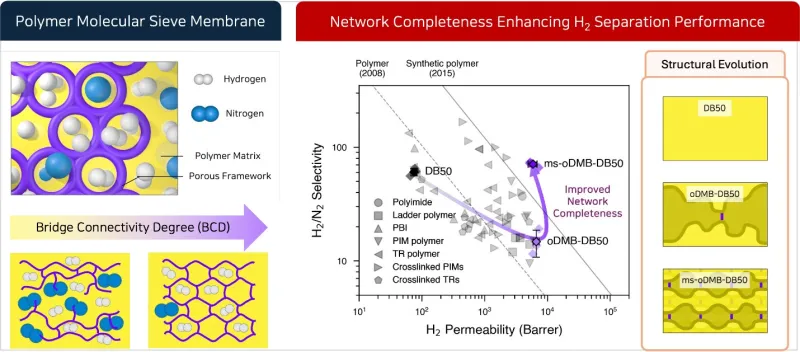
Researchers at the Korea Advanced Institute of Science and Technology (KAIST), led by Professor Tae-Hyun Bae of the Department of Chemical and Biomolecular Engineering, have developed a novel polymer membrane design that significantly improves the separation of high-purity hydrogen. The work was published in the journal Nature Communications.
The team introduced hydrogen-selective transport pathways at the angstrom scale within polymer membranes. By engineering these ultra-small channels, the membranes can more effectively filter hydrogen from mixed gas streams, a critical step in producing clean hydrogen fuel.
According to the study, the new membrane design enhances both hydrogen permeability and selectivity, which are key performance metrics for gas separation membranes. This advancement could lower the energy cost and increase the efficiency of hydrogen purification processes, supporting the broader adoption of hydrogen as a clean energy source.
The research is part of ongoing efforts to develop sustainable and cost-effective technologies for the hydrogen economy. The KAIST team's findings offer a promising route to overcome existing limitations in membrane-based gas separation.