New research is challenging long-held theories about where the Earth's original building materials formed in the early solar system. A study published in the journal Science Advances analyzed the iron isotopic composition of various meteorites and planetary bodies.
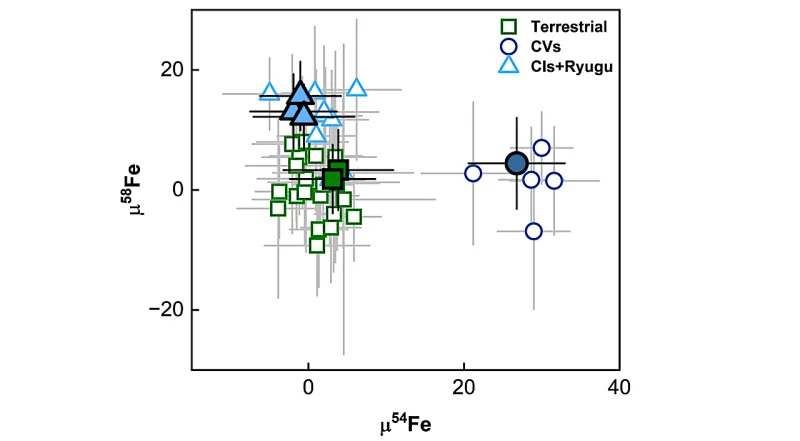
The research indicates that the iron isotope ratios in Earth's mantle are distinct from those of chondritic meteorites that formed close to the sun. Instead, Earth's composition shows similarities to material that accreted farther out in the protoplanetary disk, beyond the orbit of Mars.
This finding contradicts a previous hypothesis that suggested Earth formed from material similar to CI (Ivuna-type) chondrites, which are thought to originate from the outer solar system. The new data implies a more complex accretion history, possibly involving material migrating inward from cooler regions of the disk.
Scientists use these isotopic signatures as a forensic tool to trace the origins of planetary bodies. Understanding where Earth's iron came from is crucial for modeling the dynamics of the early solar system and the processes that led to the formation of our habitable planet.