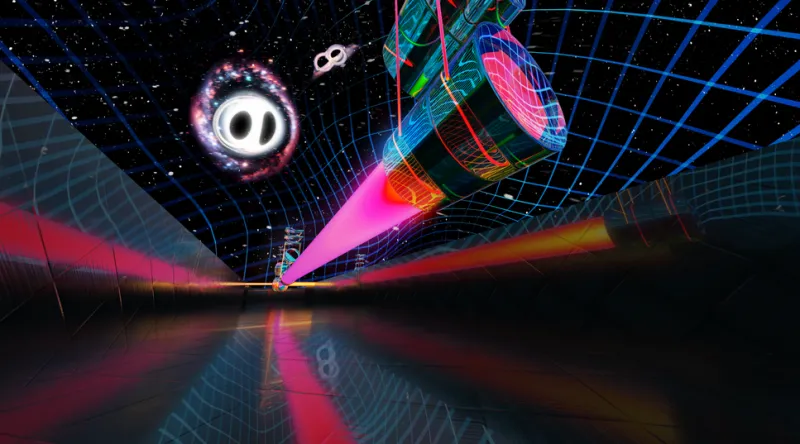
Since the first confirmed detection of gravitational waves in 2015 by the Laser Interferometer Gravitational Wave Observatory (LIGO), scientists have recorded over 390 gravitational wave events. This growing catalog has opened a new window into the universe, allowing researchers to study black holes and neutron stars in unprecedented detail.
A new study proposes a calibration method that could 'autotune' gravitational wave detectors, improving their accuracy. The technique uses astrophysical sources, such as binary neutron star mergers, to calibrate the instruments, potentially reducing systematic errors in measurements.
Researchers suggest this approach could enhance the sensitivity of detectors like LIGO, Virgo, and KAGRA, enabling more precise observations of cosmic events. The method leverages known properties of gravitational wave signals to fine-tune detector responses, similar to how autotune corrects pitch in music.
While still in the proposal stage, this calibration technique could help scientists extract more information from future gravitational wave detections, advancing our understanding of the universe's most violent phenomena.