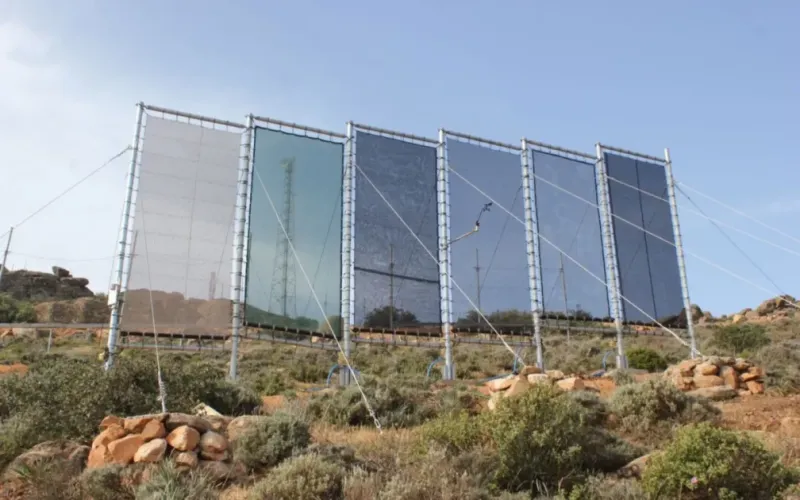
In the arid Aït Baamrane region near Sidi Ifni, Morocco, the non-profit foundation Dar Si Hmad operates a large-scale fog water harvesting system. The project, recognized by the United Nations, uses vertical mesh nets installed on Mount Boutmezguida to capture water droplets from dense fog rolling in from the Atlantic Ocean.
The collected water condenses on the nets and flows through pipes to storage tanks. After filtration and treatment, it is distributed to several rural villages. This system provides a sustainable, alternative water source in an area facing severe water scarcity and climate change pressures.
While initial reports cited 124 panels, recent updates from the foundation and UN agencies describe an expanding network. The project is considered one of the world's largest operational fog-collection systems, delivering thousands of liters of water daily to hundreds of households and local schools.
The technology, while simple, offers a crucial adaptation strategy. It reduces the time communities, particularly women and girls, spend fetching water from distant wells, allowing more time for education and other activities.